Corpus Christi, TX · Garage Door Service
Installing a new garage door in Corpus Christi means dealing with 30-40 year old openings built in the 1985-1994 boom. Here's what that job actually involves.
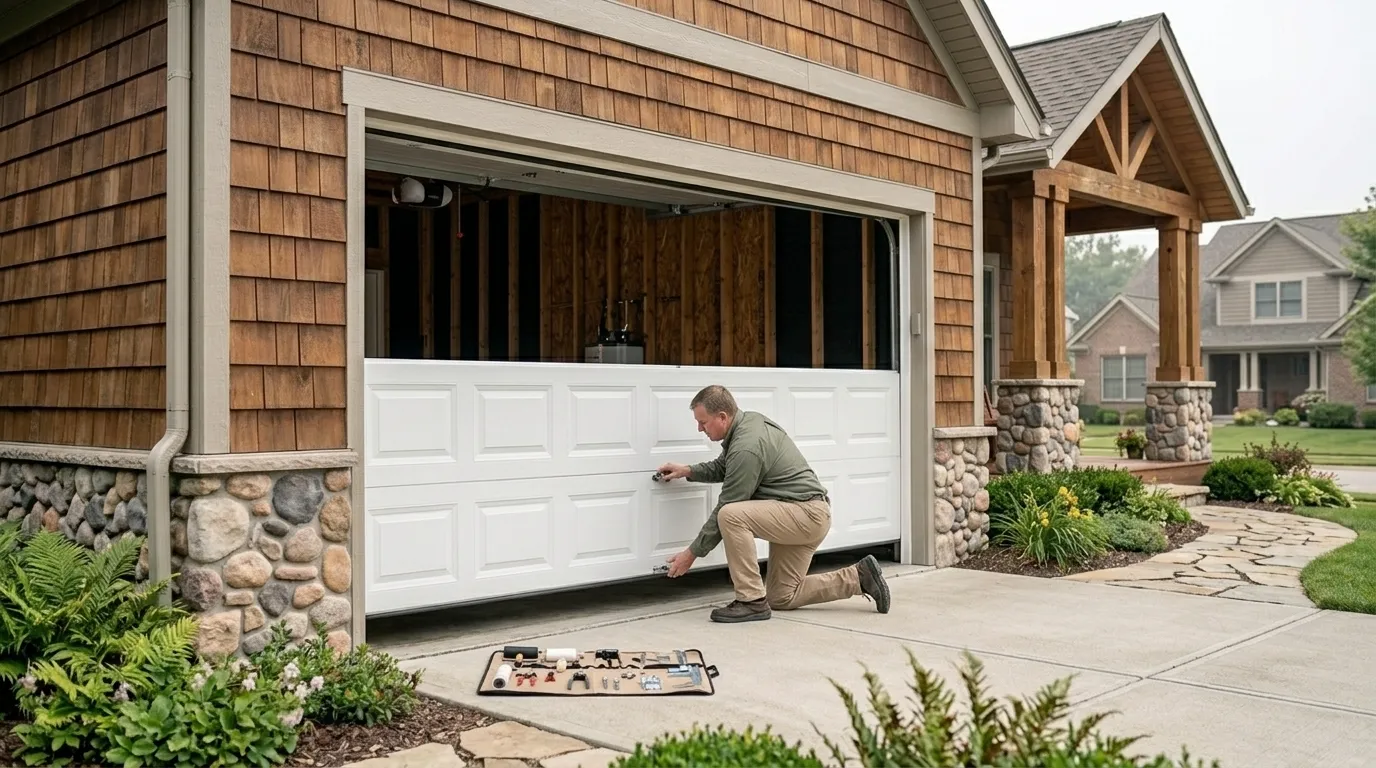
An installation job here almost never starts with an empty opening. Most houses across the service area went up between 1985 and 1994, which means we're pulling out a door that's 30 to 40 years old, along with a track, hinges, and often an opener that was never touched after the builder hung it. The old jamb has to come out clean, the header gets checked for rot or settling, and the new track has to sit plumb before a single panel goes up. If the opening is out of square - common once a house passes the 30-year mark - we shim and correct before we hang anything, not after.
We also size the new door to match the opening rather than assume it matches the old one. Framing shifts over decades, even in a mild climate, and a door that's off by half an inch on either side will bind on the rollers within a year. Once the door's up, the opener gets wired, the travel limits set, and the safety reversal tested before we call it done. None of that shows in a photo, but skip a step and the door either won't seal or won't last.
Corpus Christi's housing stock is concentrated in a narrow window - most of it built in the 1980s and 90s across the four main residential areas in town. That means a huge share of garage doors are aging out at roughly the same time, which is why installation calls cluster around the same builder-grade doors and torsion setups.
The mild temperate climate here doesn't do the freeze-thaw cracking that shows up in colder regions, so panels and seals often look fine from the driveway. What actually fails is quieter: springs losing tension, rollers wearing oval, tracks pulling out of alignment from decades of humid Gulf air moving through the garage. A door can run smooth right up until the day a cable snaps, and by then replacement is usually the honest answer, not another patch repair on 35-year-old hardware.
The biggest complication on older installs is finding parts that match what's already there. A door from the late 80s or early 90s often runs on a track width or spring size that current manufacturers don't carry anymore, so a straight swap isn't always possible - we're matching the new door to today's hardware, not the original spec.
Electrical is the second issue. Openers from that era were wired for single-function remotes with no safety-eye sensor, since that requirement came later. Installing a new door usually means adding sensor brackets and running new low-voltage wire, which takes longer than the door swap itself if the garage wasn't pre-wired for it.
We'll say plainly what we won't do: if the framing around the opening has structural rot or the header's compromised, that's a carpentry job first, and we're not going to hang a new door on a header that won't hold it. That work has to happen before installation, not instead of it.
The clearest sign it's time to install rather than repair again is a door that needs a service call every year or two for a different part each time - spring one year, rollers the next, opener gear after that. On a 30-plus year old door, that pattern means the whole system is wearing out together, not failing in isolated spots.
Other signs: the door sags visibly at the bottom corners when open, it takes noticeably more force to lift by hand than it used to, or the opener strains and reverses on its own partway through a cycle. None of these are single-part fixes on a door built during the area's original construction wave - they're the whole unit telling you its service life is up. At that point a new install costs less over five years than another round of patch repairs on hardware nobody makes anymore.
If you're calling for a different part every year or two - spring, then rollers, then opener - the whole system is wearing out together, which usually means your door was part of the original 1985-1994 construction wave. At that point a full install is usually cheaper over time than another single-part fix.
Not always. Framing shifts over 30-40 years even in a mild climate, and older openings were often built to track widths that current doors don't match exactly. We measure the actual opening and correct for any drift before the new door goes in, rather than assuming the old dimensions still work.
Often, yes. Openers installed in the 1980s and 90s predate the safety-eye sensor requirement, so a new install usually means adding sensor brackets and running new low-voltage wire. That's a normal part of bringing an older garage up to a current, safe setup.
Call now or request a free quote - same-day service on most repairs, upfront written pricing.
