Corpus Christi, TX · Garage Door Service
Broken torsion or extension spring on your Corpus Christi garage door? We fix the failure mode common to 1980s-90s coastal-built homes across the service area.
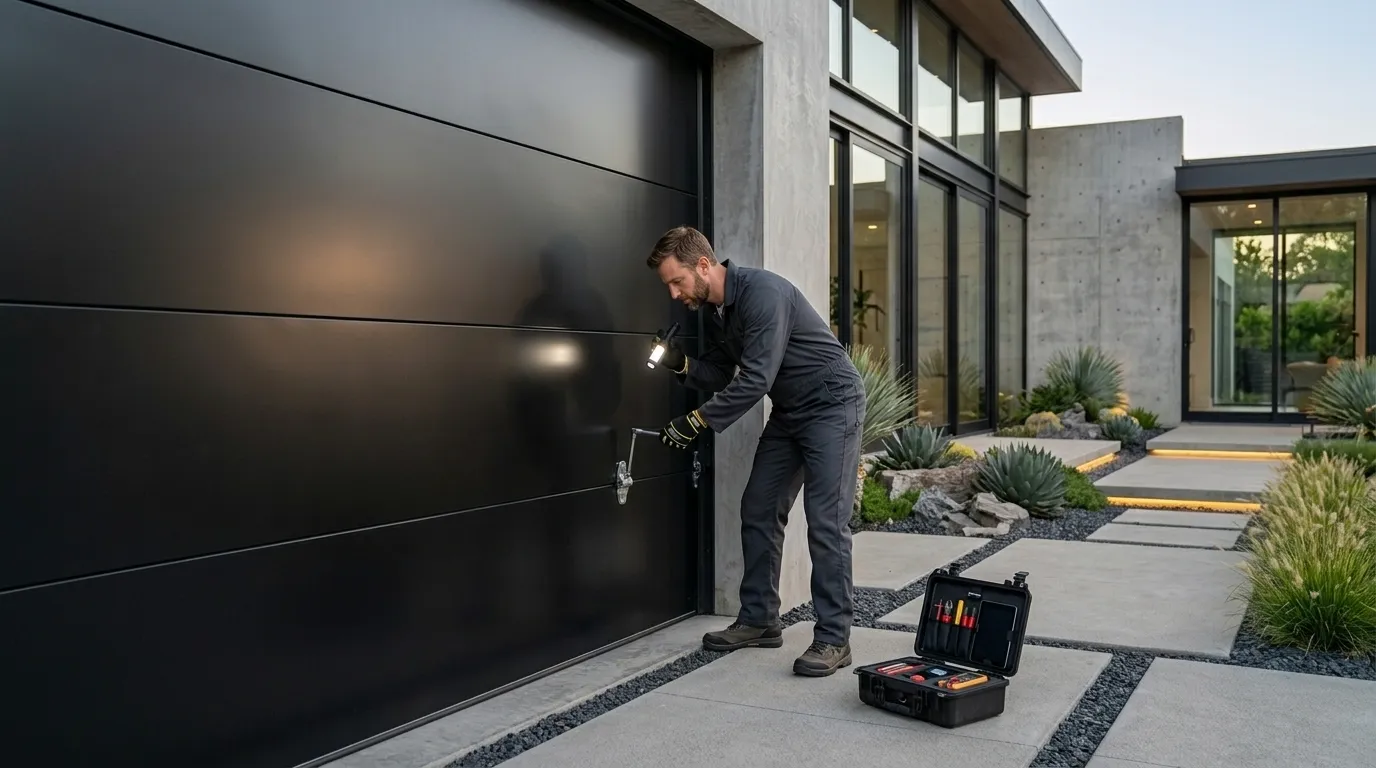
A torsion spring repair on a standard double door means winding down the old spring safely, pulling the shaft, and setting a matched pair sized to the door's weight and drum ratio. Extension spring jobs on single doors run faster because there's no shaft to pull, just the two side springs and their safety cables. Either way, the door comes off the opener during the job - we don't let an opener try to lift a door with no spring tension, because that burns out the motor fast.
Most of the houses we work on in this service area were built between 1985 and 1994, which means original torsion hardware on steel shafts that have never been touched. That's a 30-to-40-year-old spring on most calls, and at that age the wind count and wire gauge on the door often don't match what a big-box replacement kit ships with. We measure the old spring's wire diameter, coil length, and inside diameter before we cut anything loose, because a spring that's close but not matched will either strain the opener or fail again within a year.
One limit worth saying plainly: if the drums, bearing plates, or shaft are pitted or bent from the old spring failing hard, we replace those parts too. Swapping just the spring onto worn hardware is a repair that doesn't hold.
Springs fail from cycle count and from environment, and this area gives them both. The mild temperate climate here doesn't freeze springs the way a northern winter would, but the steady coastal humidity works the other side of the problem - it gets into the coil finish and the steel underneath faster than dry inland air does, and a spring quietly losing tensile strength doesn't announce itself until the day it snaps.
Housing stock matters just as much. Most of the areas we cover are built out from that 1985-1994 wave, and a lot of those original springs are original, period - nobody's replaced them because the door has kept working fine, right up until it doesn't. A spring rated for a 20-year service life that's sat on a garage door for 35 years in salt-heavy air is not an unusual find on our trucks; it's most of our calls.
We don't see the newer galvanized, coated springs failing at the same rate, because that coating slows the corrosion that eats older bare-wound coils. If your door still has its factory spring from a house built in that late-80s/early-90s window, age and salt air are working against it every day it sits unused, not just the days you open it.
The complication homeowners run into most is timing versus hardware match. A torsion spring is under enough stored force to break a hand or a wrist if it's wound or unwound without the right bars and clamps - this isn't a job to stage with a ladder and a socket set on a Saturday. We see this go wrong when someone's tried a DIY wind-down first and the shaft's already shifted in the bearing plates by the time we get the call.
The other complication is sourcing the right spring fast. With roughly 9,517 owner-occupied houses across this service area built mostly in that same 1980s-90s window, we carry a working stock of the wind counts and wire gauges that match that era's door weights, rather than ordering blind after we're on site. That's the difference between a same-visit fix and a return trip.
Cost is the third piece, and we'll say it straight: a double door needing two matched torsion springs plus new cable and drums costs more than a single spring swap, and we won't quote you a one-spring price and then find the second one's just as worn once the shaft's exposed - both springs get replaced together, or the door comes back unbalanced within months.
The clearest sign is a door that won't stay put - it slams down from halfway, or the opener strains and reverses because it's trying to lift dead weight the spring used to carry. A loud bang from the garage, usually when nobody's touched the door, is a torsion spring letting go; the door is usually still closed and looks fine until you try to open it by hand and it won't budge, or it flies up too fast because only one of a pair broke and the other's overcompensating.
A door that feels heavier than it used to, that you have to help lift, or that the opener now takes longer to raise, is a spring losing tension gradually rather than snapping outright - that's the more common call in this area given how many original springs are still in service on houses from that 1985-1994 build wave. Either version is a repair call, not a wait-and-see: an opener fighting a bad spring burns out its own motor and gears, turning a spring job into an opener replacement if it sits too long.
We don't quote a flat number without seeing the door, because single vs. double, torsion vs. extension, and hardware condition all change the price. What we can say from the calls we run across this service area: double doors needing two matched torsion springs cost more than a single-spring job, and we quote both springs together, not one at a time.
On a double door with two torsion springs, no - we replace both. If one has failed from age, the other is the same age and under the same load history, and it's usually close behind. Replacing one leaves the door unbalanced and the opener straining on the worn side, which is how a spring call turns into an opener call.
Most residential springs are rated for a set number of open-close cycles, and in this climate the steady coastal humidity also works on the coil finish over time. On a lot of the 1980s-90s houses in this service area, the spring is original to the house - decades past a normal service life - so the actual break often just catches up to years of quiet wear.
By Neighborhood
We also handle spring repair in these Corpus Christi-area suburbs.
Call now or request a free quote - same-day service on most repairs, upfront written pricing.
